News

News

The Second Phase in the Architectural Design Process: Schematic Design

What is Schematic Design?

After a full understanding of the specific approach, operation style, project goals and future growth has been developed, CNH Architects can enter the Schematic Design (SD) phase. Like a Study of Program Needs, SD is a critical process that sets the foundation for the entire project going forward. While the Study of Program Needs outlines requirements for the building and budget, the SD phase is where practicality and creativity meet. SD takes programming further with creative concepts that will be translated to architectural and spatial designs, shaping the project on paper.


Clear Direction
Establishing an agreed-upon direction – with clarity – is vital to the success of any project. During the SD phase, architects work closely with stakeholders to define (or reiterate) guiding principles, goals, and functionality. To do this, CNH Architects considers the following.

Sustainability: While impacted by decisions made throughout the entire process, the discussion regarding environmental sustainability will begin now. CNH Architects is diligent in ensuring all aspects of sustainable design will be considered to improve the facility and benefit the occupants, while determining the best balance of features with the appropriate budget.

Spatial Relationships and General Aesthetics: This involves planning the layout of spaces, circulation paths, and connections between different areas – all while introducing exterior materials and their suitability for the project’s image and functionality.
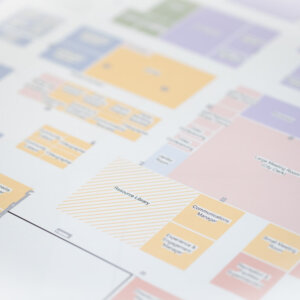
Site Analysis: Strong schematic design focuses on site analysis in terms of climate, context, and surroundings. It reviews the site’s current conditions (including topography, vegetation, and existing structures) and defines landscaping, access points, parking, orientation, and views.


Collaboration
During SD, our team will collaborate closely with the client. Together they will explore conceptual design options, developing floor plans and building massings. After careful listening, the exterior image will be developed, working towards narrowing the design options to focus on a single schematic design concept. As this phase is wrapping up, our team will assist in providing the schematic cost estimate, providing feedback, and validating the schematic design or providing insights to adjustments needed. By the end of this phase, the project team will have a preliminary understanding of the scale of the project and the systems (such as structural, mechanical, and electrical) that will be needed – leading us into the construction phase.


Headquartered in Apple Valley, MN – CNH Architects, Ltd. is a creative, service-oriented firm that provides innovative design solutions for municipal and public, commercial, retail, vehicle, daycare, and animal care facilities. CNH has served clients in the Twin Cities and upper Midwest since 1969.

Share this:

The Second Phase in the Architectural Design Process: Schematic Design

What is Schematic Design?

After a full understanding of the specific approach, operation style, project goals and future growth has been developed, CNH Architects can enter the Schematic Design (SD) phase. Like a Study of Program Needs, SD is a critical process that sets the foundation for the entire project going forward. While the Study of Program Needs outlines requirements for the building and budget, the SD phase is where practicality and creativity meet. SD takes programming further with creative concepts that will be translated to architectural and spatial designs, shaping the project on paper.


Clear Direction
Establishing an agreed-upon direction – with clarity – is vital to the success of any project. During the SD phase, architects work closely with stakeholders to define (or reiterate) guiding principles, goals, and functionality. To do this, CNH Architects considers the following.

Sustainability: While impacted by decisions made throughout the entire process, the discussion regarding environmental sustainability will begin now. CNH Architects is diligent in ensuring all aspects of sustainable design will be considered to improve the facility and benefit the occupants, while determining the best balance of features with the appropriate budget.

Spatial Relationships and General Aesthetics: This involves planning the layout of spaces, circulation paths, and connections between different areas – all while introducing exterior materials and their suitability for the project’s image and functionality.

Site Analysis: Strong schematic design focuses on site analysis in terms of climate, context, and surroundings. It reviews the site’s current conditions (including topography, vegetation, and existing structures) and defines landscaping, access points, parking, orientation, and views.


Collaboration
During SD, our team will collaborate closely with the client. Together they will explore conceptual design options, developing floor plans and building massings. After careful listening, the exterior image will be developed, working towards narrowing the design options to focus on a single schematic design concept. As this phase is wrapping up, our team will assist in providing the schematic cost estimate, providing feedback, and validating the schematic design or providing insights to adjustments needed. By the end of this phase, the project team will have a preliminary understanding of the scale of the project and the systems (such as structural, mechanical, and electrical) that will be needed – leading us into the construction phase.


Headquartered in Apple Valley, MN – CNH Architects, Ltd. is a creative, service-oriented firm that provides innovative design solutions for municipal and public, commercial, retail, vehicle, daycare, and animal care facilities. CNH has served clients in the Twin Cities and upper Midwest since 1969.

Share this:
Scroll to Top

BURNSVILLE FIRE STATION NO. 1

CNH’s largest fire station to date, the City of Burnsville’s Fire Station No. 1 is home to a crew of all full-time firefighters and more than 44,000 SF with 10 apparatus bays. Firefighter safety was one of nine top priorities for the station. Multiple contamination zones and a designated de-contamination area will allow firefighters to keep contaminated equipment and clothing in the apparatus bay until decontaminated. Another priority in the design was firefighter mental health. A warning system that slowly ramps up with alert tones and lighting while only alerting responding staff ensures firefighters are not awoken in an abrupt manner. The station includes areas for relaxation with different lighting to promote natural sleep rhythms, as well as a yoga studio and meditation garden. Extensive firefighter training features including Firefighter 1 and advanced training elements are another highlight of the station.